2026 Guide: Building an Automated AI Feedback Analysis Engine for Your Business

By Abo-Elmakarem Shohoud | Ailigent
Introduction: The Shift from 'What' to 'Why' in 2026
 Best Artificial Intelligence training institute in Delhi
Source: Dev.to AI
Best Artificial Intelligence training institute in Delhi
Source: Dev.to AI
As we navigate the mid-point of 2026, the business landscape has moved beyond simple data collection. Most companies are drowning in quantitative metrics—conversion rates, churn percentages, and net promoter scores. However, as Abo-Elmakarem Shohoud often emphasizes at Ailigent, numbers tell you that something happened, but they rarely tell you why. To thrive this year, businesses must master the art of qualitative analysis at scale.
Open-ended surveys are the primary tool for uncovering these hidden motivations. Unlike multiple-choice questions, they allow customers to express themselves in their own words. The challenge, historically, was the manual labor required to read and categorize thousands of responses. In 2026, we solve this using Agentic AI and real-time processing operating on specialized hardware like the Hexagon DSPs found in modern mobile processors.
Open-ended Survey Analysis is the process of using Natural Language Processing (NLP) and Large Language Models (LLMs) to automatically extract themes, sentiments, and actionable intents from unstructured text data. This guide will walk you through building a production-ready engine to automate this process.
Prerequisites
Before starting, ensure you have the following:
- An API key for a frontier LLM (e.g., GPT-5, Claude 4, or a locally hosted Llama 4).
- A survey tool with Webhook support (Typeform, SurveyMonkey, or a custom React frontend).
- Basic knowledge of Python and asynchronous API calls.
- A vector database (like Pinecone or Weaviate) for long-term sentiment tracking.
Step 1: Designing Your Data Collection Strategy
In 2026, the quality of your AI output is strictly tied to the quality of your prompt engineering and survey design. Avoid leading questions. Instead of asking "How much did you like our new AI feature?", ask "How has the new AI feature impacted your daily workflow?"
Agentic AI is a paradigm where autonomous software entities are given specific goals and allowed to use tools and reasoning to achieve them without step-by-step human intervention. In this step, you are designing the 'environment' for your AI agent to operate in.
Step 2: Implementing Real-Time Data Ingestion
You don't want to wait until the end of a campaign to analyze results. Use a serverless function (AWS Lambda or Google Cloud Functions) to listen for survey completions.
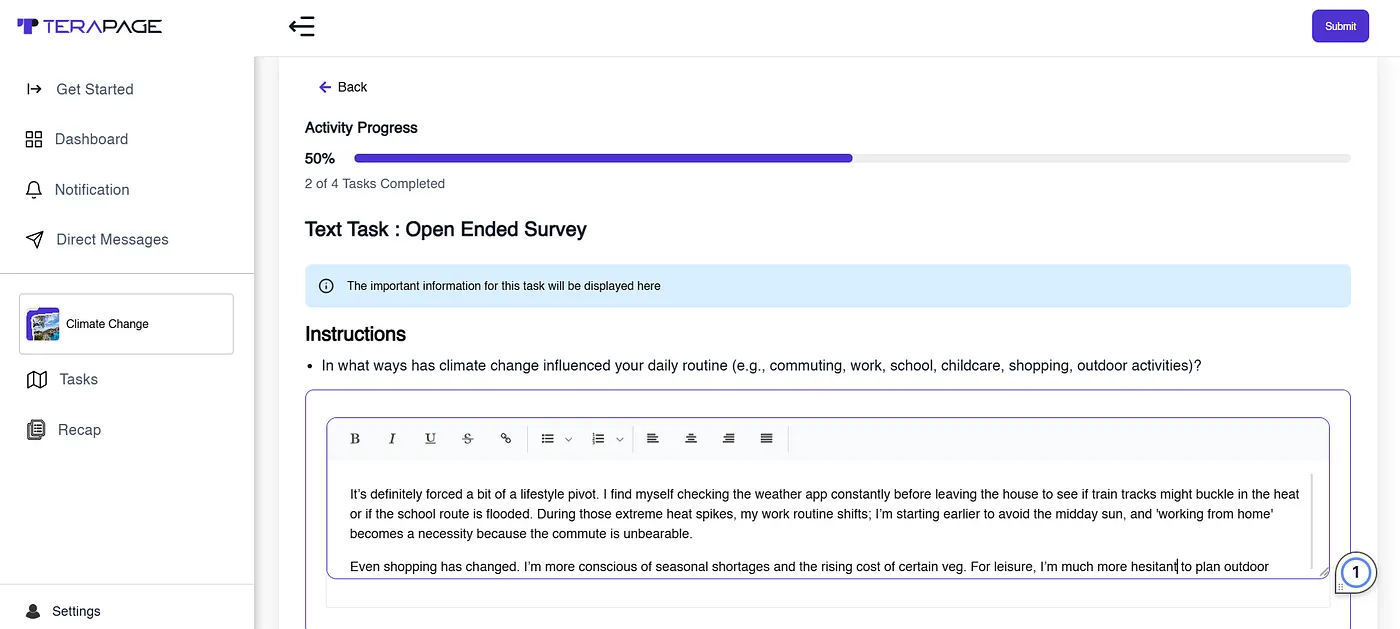 What Is an Open-Ended Survey? Definition, Benefits, AI Analysis & How to Create One
Source: Dev.to AI
What Is an Open-Ended Survey? Definition, Benefits, AI Analysis & How to Create One
Source: Dev.to AI
import json
import requests

def survey_webhook_handler(event, context):
    data = json.loads(event['body'])
    raw_text = data.get('response_text')
    customer_id = data.get('user_id')

    # Trigger the AI Analysis Pipeline
    analysis_result = analyze_sentiment_and_intent(raw_text)

    # Store in Vector DB for 2026 trend tracking
    store_in_db(customer_id, raw_text, analysis_result)

    return {"statusCode": 200, "body": "Analysis Complete"}
Step 3: Leveraging Edge AI for Privacy and Speed
One of the most significant breakthroughs in 2026 is the widespread use of real-time operating systems like QuRT on mobile devices to process data locally. By utilizing the Hexagon DSP (Digital Signal Processor), your mobile app can perform initial sentiment filtering before the data even reaches your servers. This ensures user privacy and reduces cloud compute costs.
Edge AI is a paradigm where data is processed locally on the device (like a smartphone or IoT sensor) rather than being sent to a centralized cloud server, enabling lower latency and better privacy.
Step 4: Multi-Dimensional Analysis with LLMs
Don't just ask the AI for "positive" or "negative." In 2026, we use "Chain of Density" prompting to get deep insights. Your prompt should instruct the AI to identify:
- Primary Emotion: (Frustration, Delight, Confusion)
- Key Feature Mentioned: (UI, Speed, Price)
- Actionability: (Is this a bug report or a feature request?)
- Urgency Score: (1-10)
| Traditional Analysis (Pre-2024) | AI-Driven Analysis (2026) |
|---|---|
| Manual coding of themes | Automated semantic clustering |
| Weekly or monthly reporting | Real-time dashboard updates |
| Limited to top 10% of responses | 100% coverage of all qualitative data |
| High human bias | Consistent, objective sentiment scoring |
Step 5: Closing the Loop (Automation)
At Ailigent, we believe analysis without action is wasted compute. Integrate your analysis engine with your CRM (Salesforce or HubSpot). If a high-value customer submits an open-ended response with an "Urgency Score" > 8 and a "Primary Emotion" of "Frustration," automatically trigger a Slack alert for your Customer Success team.
Troubleshooting Section
- Issue: AI Hallucinations in Summaries.
- Solution: Use a "Reflective Prompting" technique where a second AI agent verifies the summary against the original text.
- Issue: High Latency in Real-Time Feedback.
- Solution: Offload initial processing to the device's DSP using frameworks like Qualcomm's AI Stack to filter non-essential data.
- Issue: Inconsistent Sentiment Scoring.
- Solution: Provide the LLM with a 1-shot or few-shot example of your specific industry's jargon to calibrate its understanding.
Key Takeaways
- Qualitative is King in 2026: Open-ended surveys provide the 'why' that quantitative data lacks, and AI is the only way to scale this insight.
- Privacy via Edge AI: Utilize on-device processing (like Hexagon DSPs) to handle sensitive customer feedback locally when possible.
- Actionable Orchestration: Don't just analyze; connect your AI engine to your business tools to automate responses to customer needs.
- Continuous Education: As highlighted in recent Delhi AI training summits, staying updated on Agentic AI workflows is no longer optional for tech professionals this year.
Bottom Line: By automating the analysis of open-ended surveys, you transform a pile of text into a strategic roadmap. In 2026, the competitive advantage belongs to those who listen to their customers at the speed of light.
Related Videos
Turn Open-ended Survey Data into Insights with AI
Channel: Philip Adu, Ph.D
Using AI for thematic coding of open-ended questions in survey data
Channel: Project Dragonfly