Building a Secure AI-Powered Enterprise Document Management System (EDMS) in 2026

By Abo-Elmakarem Shohoud | Ailigent
Introduction
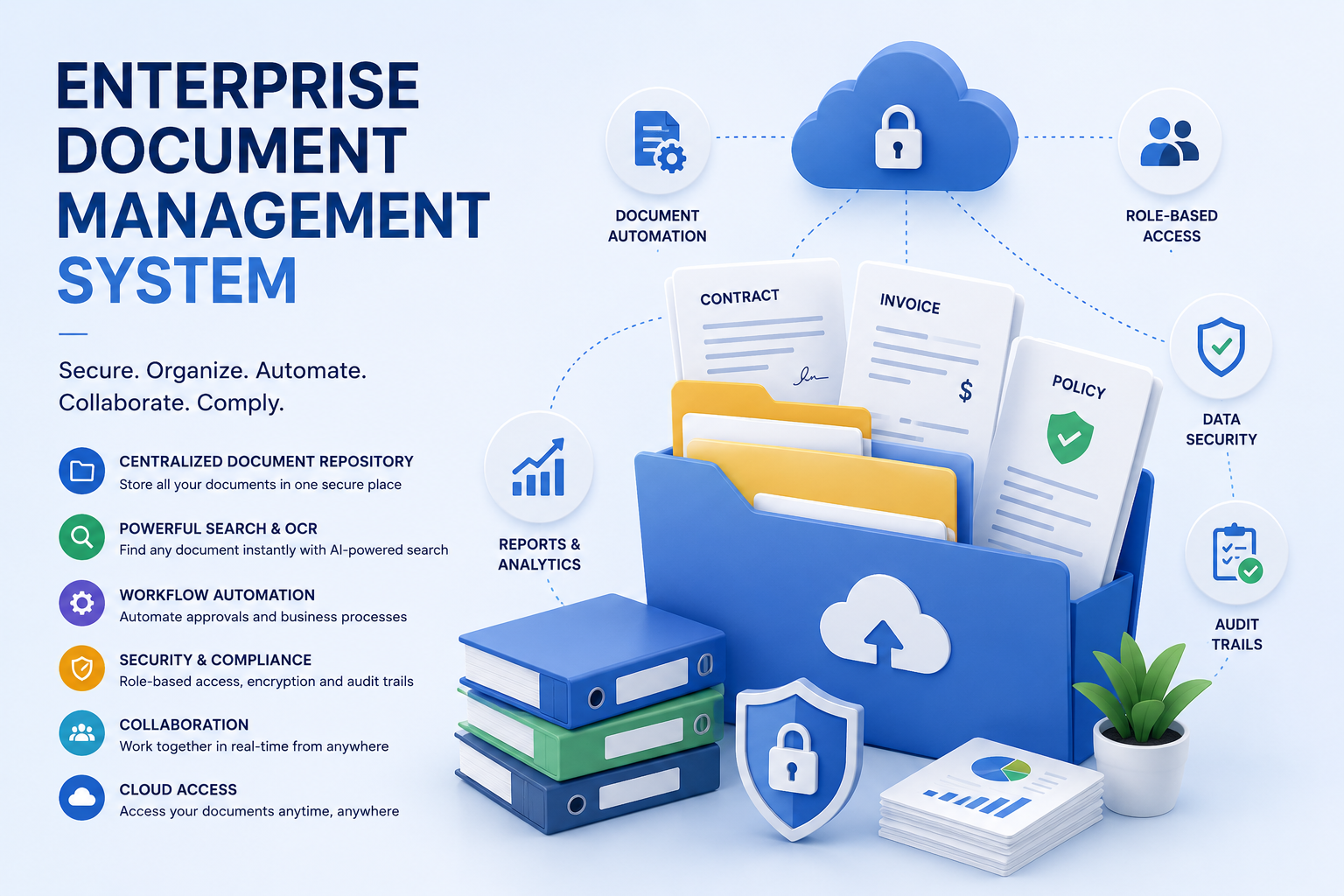 Enterprise Document Management System | Secure AI Document Solution
Source: Dev.to AI
Enterprise Document Management System | Secure AI Document Solution
Source: Dev.to AI
As we navigate through July 2026, the volume of digital data produced by organizations has reached unprecedented levels. The traditional methods of storing files in nested folders are no longer sufficient. Today, an Enterprise Document Management System (EDMS) is not just a digital filing cabinet; it is the central nervous system of business intelligence. In this guide, I will walk you through building a modern, secure, and AI-driven EDMS that solves the core problems of searchability, security, and automated processing.
Enterprise Document Management System (EDMS) is a software solution used to track, manage, and store documents, reducing paper and improving workflow efficiency through centralized control.
At Ailigent, we believe that the true value of AI in 2026 lies in its ability to transform unstructured data—like PDFs and scanned invoices—into actionable insights. By following this guide, you will learn how to build a system that doesn't just store files but understands them.
Prerequisites
Before we begin, ensure you have the following:
- Node.js (v24+): The current industry standard for high-performance server-side logic.
- Vector Database Access: (e.g., Pinecone or Milvus) for semantic search capabilities.
- LLM API Keys: Access to advanced models like GPT-5 or Claude 4.0 for document reasoning.
- Cloud Storage: AWS S3 or Google Cloud Storage for scalable file hosting.
Step 1: Architecting for Scalability and Intelligence
In 2026, architecture must be "Agentic." This means designing the system to support AI agents that can perform tasks autonomously.
Agentic AI is a paradigm where AI systems are designed to independently pursue complex goals, using tools and reasoning to complete tasks with minimal human intervention.
Your architecture should consist of a microservices-based backend where the AI processing layer is decoupled from the storage layer. This allows you to scale the heavy computational needs of OCR (Optical Character Recognition) and LLM embedding independently from the user interface.
Step 2: Securing the Node.js Backend
Security is the biggest hurdle for enterprise adoption. Most vulnerabilities in 2026 still stem from basic coding errors. As highlighted in recent security audits, we must protect against Injection and Broken Access Control.
Actionable Security Measures:
- Input Validation: Never trust user input. Use libraries like
ZodorJoito enforce strict schemas. - Helmet.js: Use this to set various HTTP headers to secure your Express apps.
- JWT with Short Expiry: Ensure all document access is authenticated via encrypted tokens.
 How to Make Money Online in 2026: A Practical Guide for Beginners.
Source: Dev.to AI
How to Make Money Online in 2026: A Practical Guide for Beginners.
Source: Dev.to AI
// Example: Secure Header Implementation in Node.js
const express = require('express');
const helmet = require('helmet');
const app = express();

// Use Helmet to protect against common vulnerabilities
app.use(helmet());

// Strict Input Validation Middleware
const validateDocumentUpload = (req, res, next) => {
    const { title, department } = req.body;
    if (typeof title !== 'string' || title.length > 255) {
        return res.status(400).send('Invalid Title');
    }
    next();
};
Step 3: Integrating AI for Intelligent Processing
The differentiator of a 2026 EDMS is its ability to perform "Semantic Search" rather than just keyword matching. This requires converting documents into high-dimensional vectors.
- Extraction: Use specialized AI models to extract text from images and layouts.
- Embedding: Convert the text into vectors using an embedding model.
- Storage: Save these vectors in a Vector Database.
When a user asks, "What were our total liabilities in the Q3 2025 contracts?", the system doesn't look for the word "liabilities"; it understands the concept and retrieves the relevant sections from thousands of pages.
Step 4: Building the Comparison Layer
To help your business stakeholders understand the value, you must demonstrate how the AI-driven approach outperforms legacy systems.
| Feature | Legacy EDMS (Pre-2024) | Modern AI EDMS (2026) |
|---|---|---|
| Search Type | Keyword-based (Exact match) | Semantic (Context-based) |
| Data Entry | Manual tagging and metadata | Automated AI extraction |
| Security | Static Role-Based Access | Contextual & Behavioral Security |
| Workflows | Hard-coded logic | Agentic AI Autonomy |
| Insights | Requires manual reporting | Real-time AI analytics |
Step 5: Monetization and Business Value
Building an online income in 2026 is about solving real problems for businesses. An AI-powered EDMS is a high-value product. You can offer this as a SaaS (Software as a Service) or as a bespoke automation consultancy. Abo-Elmakarem Shohoud emphasizes that the "Internet rewards those who create value." By automating the document lifecycle, you are saving enterprises thousands of hours in manual labor, which directly translates to high-ticket contract opportunities.
Troubleshooting Common Issues
- High Latency in AI Responses: Use asynchronous processing. Acknowledge the file upload immediately and use WebSockets to notify the user when the AI processing is complete.
- Token Cost Management: Implement document chunking. Don't send a 500-page PDF to an LLM in one go; summarize sections and use a RAG (Retrieval-Augmented Generation) pipeline.
- Inaccurate OCR: In 2026, ensure you are using multi-modal models that can handle complex layouts, tables, and handwritten notes.
Key Takeaways
- Security First: Use Node.js best practices like Helmet and strict input validation to protect sensitive enterprise data.
- Adopt Agentic AI: Move beyond simple storage; build a system that can reason and automate workflows autonomously.
- Focus on Value: In the 2026 economy, the most profitable online businesses are those that solve complex organizational inefficiencies like document clutter.
- Leverage Semantic Search: Use vector databases to provide users with an intuitive, Google-like search experience for their internal documents.
Bottom Line
The transition from traditional document management to an AI-integrated ecosystem is the most significant shift for businesses this year. By combining the security of Node.js with the intelligence of Agentic AI, you position yourself at the forefront of the 2026 tech landscape. Whether you are building this for your own firm or as a service for others, the focus must remain on security, scalability, and measurable business value.
Related Videos
AI Agent Full Tutorial for Beginners 2026: How to Build AI Agents in Minutes
Channel: Mikey No Code
The Agentic Engineer Workflow You Need In 2026
Channel: Zen van Riel