Building Resilient AI Pipelines in 2026: A Guide to n8n, LLM Scraping, and Data Validation

By Abo-Elmakarem Shohoud | Ailigent
As we navigate the middle of 2026, the landscape of business automation has shifted from simple 'trigger-action' sequences to complex, self-healing Agentic AI workflows. For business owners and tech professionals, the challenge is no longer just 'making it work,' but making it resilient, scalable, and secure. Today, we are exploring a sophisticated approach to capturing real-time AI insights using n8n and LLM scrapers, while applying rigorous data validation techniques to ensure your business decisions are based on accurate information.
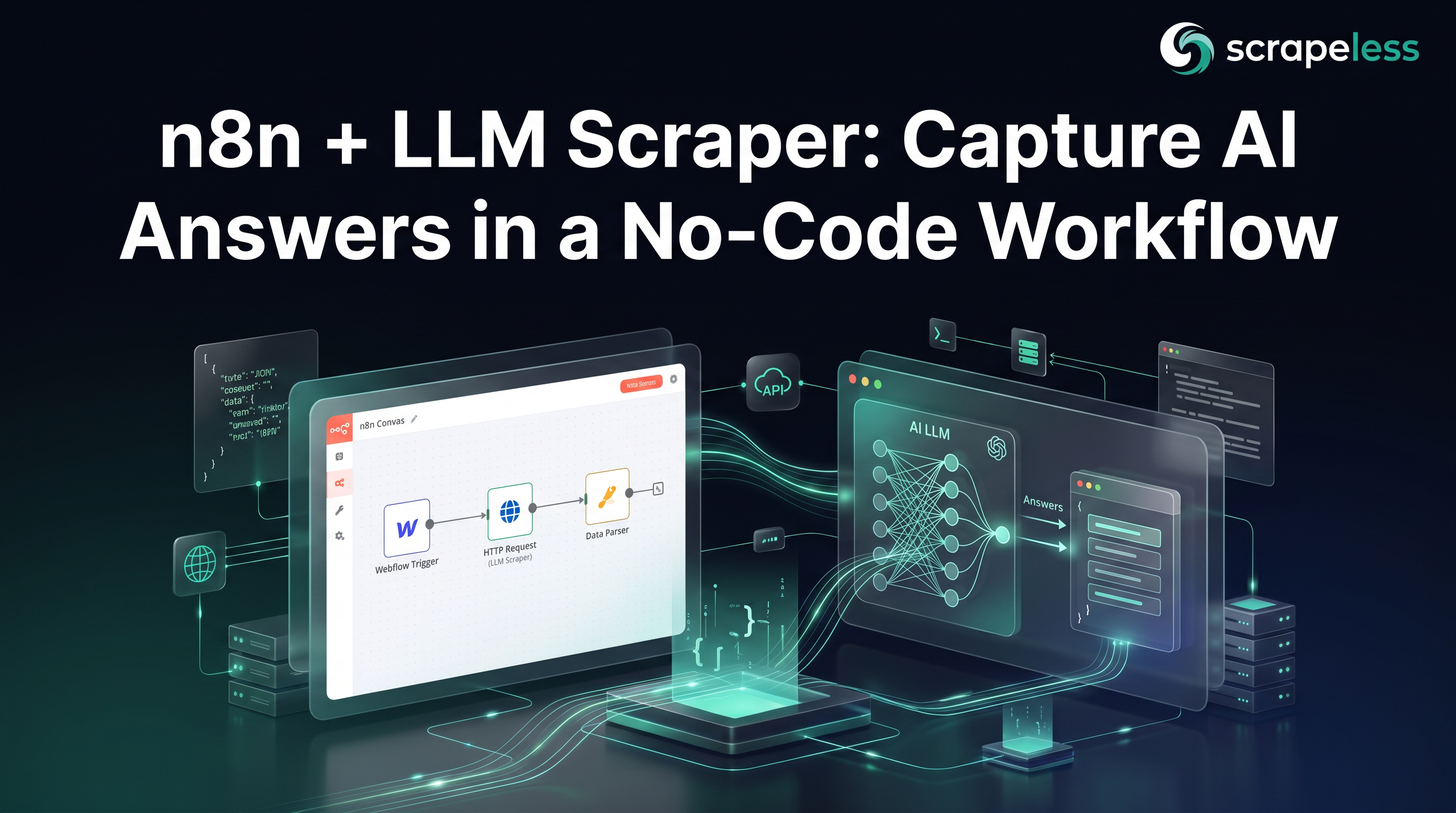 n8n + LLM Scraper: Capture AI Answers in a No-Code Workflow
Source: Dev.to AI
n8n + LLM Scraper: Capture AI Answers in a No-Code Workflow
Source: Dev.to AI
The 2026 Automation Landscape
In 2026, the global automation market has surpassed early expectations, with over 75% of mid-sized enterprises utilizing some form of low-code AI orchestration. Agentic AI is a paradigm where autonomous agents perceive their environment, reason about tasks, and execute actions to achieve specific goals without constant human intervention. This shift requires a new set of tools and a more disciplined approach to data handling.
At Ailigent, founded by Abo-Elmakarem Shohoud, we have observed that the primary failure point in modern workflows isn't the AI's logic, but the 'unclean' data it receives or generates. This guide provides a blueprint for building a production-ready pipeline that captures, validates, and processes AI-driven data.
Prerequisites
Before we begin, ensure you have the following:
- An active n8n instance (Cloud or Self-hosted).
- A Scrapeless account and API key for LLM-based web scraping.
- Basic understanding of JSON structures.
- A desire to eliminate manual data entry forever.
Step 1: Connecting n8n to the Scrapeless LLM Scraper
The traditional method of web scraping—relying on fragile CSS selectors—is effectively obsolete in 2026. LLM-based scrapers allow you to query the web using natural language. This step focuses on setting up the core connection.
No-Code AI Integration is the method of connecting large language models to external data sources and applications without writing traditional backend code.
- Open your n8n canvas and add an HTTP Request Node.
- Set the Method to
POST. - Use the URL:
https://api.scrapeless.com/api/v2/scraper/execute. - In the Headers section, add
x-api-tokenwith your Scrapeless API key. - In the Body, select
JSONand use the following structure:
{
  "actor": "scraper.chatgpt",
  "input": {
    "prompt": "Extract the current market price of Lithium and summarize the top 3 news drivers from the last 24 hours.",
    "country": "US",
    "web_search": true
  }
}
This configuration allows n8n to communicate directly with an LLM that has live web access. The response is injected back into your workflow as structured data, ready for the next node.
Step 2: Implementing 'Data Guards' for Safety
One of the biggest risks in 2026 is "Data Drift" or receiving malformed responses from AI models. To prevent your downstream systems (like your CRM or ERP) from crashing, you must implement validation. Even in a low-code environment, the principles of TypeScript Guard Utilities are essential.
 Mastering JavaScript Dates and Times
Source: freeCodeCamp
Mastering JavaScript Dates and Times
Source: freeCodeCamp
Type Guarding is a technique used to verify that a variable conforms to a specific type or schema before it is processed by the application logic.
In n8n, you can use a Code Node (JavaScript/TypeScript) to act as a 'Guard.' Instead of blindly passing the LLM output, use a script to check if the required fields exist and are of the correct type (e.g., ensuring a price is a number and not a string like "Unavailable").
// Example Type Guard in an n8n Code Node
const data = items[0].json;

function isValidResponse(input) {
    return typeof input.price === 'number' && Array.isArray(input.news_drivers);
}

if (!isValidResponse(data)) {
    throw new Error("Invalid data format received from LLM Scraper");
}

return items;
Step 3: Mastering Temporal Logic (Dates and Times)
In a globalized 2026 economy, managing timezones is a frequent source of error. Whether you are scheduling social media posts or tracking financial trades, your automation must be time-aware. JavaScript's Date object remains a challenge, but modern libraries and n8n's built-in date nodes simplify this.
When capturing data, always convert timestamps to ISO 8601 format immediately. This ensures that regardless of where your server is located, the data remains consistent. For instance, if your scraper returns a relative time like "2 hours ago," use an AI prompt or a specialized function to convert that into a fixed UTC timestamp before saving it to your database.
Comparison: Traditional Scraping vs. LLM Scraping (2026)
| Feature | Traditional Scraping (CSS/XPath) | LLM-Powered Scraping (Scrapeless) |
|---|---|---|
| Setup Time | High (Requires manual mapping) | Low (Natural language prompts) |
| Maintenance | Frequent (Breaks when UI changes) | Minimal (Adapts to UI changes) |
| Data Structure | Rigid | Flexible / Dynamic |
| Cost | Low per request | Moderate (AI compute costs) |
| Accuracy | 100% (if selector is correct) | 95-99% (requires validation) |
Step 4: Structuring the Workflow for Scale
To make this workflow business-ready, follow this structure in n8n:
- Trigger: Schedule (e.g., every morning at 8:00 AM).
- Action: HTTP Request (The Scrapeless LLM Scraper).
- Validation: Code Node (The Data Guard).
- Transformation: Date/Time Node (Standardize all timestamps to UTC).
- Output: Google Sheets / Airtable / Internal API.
By following this structure, you create a "Self-Healing" loop. If the validation fails, you can route the error to a Slack channel for manual review rather than letting corrupt data enter your primary systems.
Troubleshooting Common Issues
- Timeout Errors: LLM scraping takes longer than standard API calls. Increase the 'Timeout' setting in your n8n HTTP Request node to at least 60 seconds.
- Schema Mismatches: Sometimes the LLM might wrap the JSON in markdown code blocks. Use a regex in your Code Node to strip out
json ...before parsing. - API Rate Limits: Most 2026 API providers enforce strict limits. Use the 'Wait' node in n8n to stagger requests if you are processing large batches of URLs.
Key Takeaways
- Embrace No-Code AI: Tools like n8n and Scrapeless allow you to build complex data extraction pipelines in minutes rather than days, providing a massive competitive advantage in 2026.
- Prioritize Validation: Never trust AI output implicitly. Use "Data Guards" to verify that the information meets your business requirements before it hits your database.
- Standardize Everything: Use ISO 8601 for dates and UTC for timezones to avoid the common pitfalls of global automation.
- Ailigent's Philosophy: True automation isn't just about speed; it's about the reliability of the data that fuels your business growth.
Bottom Line
Building an AI-driven business in 2026 requires a blend of innovative tools and disciplined engineering. By combining the power of n8n's orchestration with the intelligence of LLM scrapers and the safety of data validation, you are not just automating tasks—you are building a robust digital workforce. If you're looking to implement these advanced workflows, Abo-Elmakarem Shohoud and the Ailigent team are here to help you navigate the complexities of modern AI integration.
Related Videos
How To Scrape Websites Without Paid APIs Using n8n (Full Guide 2026)
Channel: AI Mastery
How To Scrape Any Website With n8n (Easiest Way) (2026)
*Channel: Reed Tutorials *