Building Verifiable AI Automation: A 2026 Tutorial for Scalable Business Operations

By Abo-Elmakarem Shohoud | Ailigent
Learning Objectives
By the end of this tutorial, you will be able to:
- Design a multi-layered automation architecture for physical resource management.
- Implement the 'SeaHack' rapid prototyping methodology for AI startups.
- Create Executable Operational Specifications to ensure AI safety and reliability.
- Integrate IoT sensor data with Agentic AI for predictive maintenance.
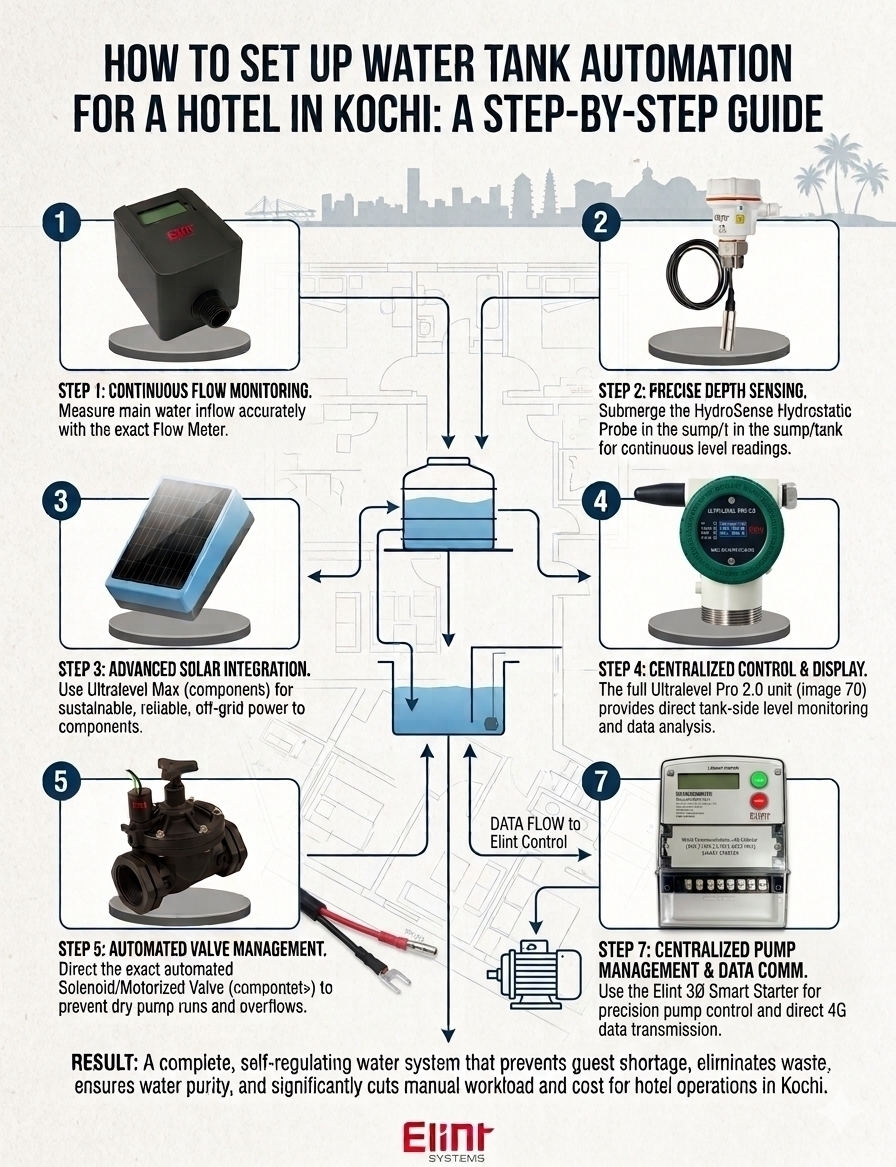 How to Set Up Water Tank Automation for a Hotel in Kochi: A Step-by-Step Guide
Source: Dev.to AI
How to Set Up Water Tank Automation for a Hotel in Kochi: A Step-by-Step Guide
Source: Dev.to AI
Introduction: The State of Automation in 2026
As we navigate the final quarter of 2026, the gap between businesses that 'use' software and businesses that are 'driven' by verifiable AI has never been wider. Whether you are managing a boutique hotel in Kochi or a global supply chain, the era of manual monitoring is dead. Today, we don't just automate; we build systems that reason, verify, and adapt.
In this tutorial, we will explore how to build a modern, verifiable automation system. We will use the practical example of water management in the hospitality sector—a challenge recently highlighted in Kochi's growing tech scene—and supercharge it with the rapid-deployment strategies seen at the recent SeaHack event in Hong Kong and the latest advancements in verifiable software specifications.
Agentic AI is a paradigm where autonomous software entities perceive their environment, reason through complex tasks, and take actions to achieve specific goals without constant human oversight.
Phase 1: The Physical Layer (IoT & Data Acquisition)
Every great automation system starts with reliable data. For our hotel water tank example, manual checks are a liability. In 2026, we utilize ultrasonic sensors connected via 6G or advanced LPWAN (Low Power Wide Area Networks) to get millimetric precision on water levels.
Step-by-Step Hardware Setup:
- Sensor Selection: Use an industrial-grade ultrasonic sensor (e.g., HC-SR04 for prototypes, or laser-based sensors for deep tanks).
- Microcontroller: Deploy an ESP32-S3 or similar edge-computing chip that supports on-device encryption.
- Connectivity: Configure the device to send data packets to your central cloud hub every 60 seconds via an MQTT broker.
At Ailigent, we often tell our clients that data quality is the 'fuel' for AI. If your sensors are noisy, your AI will be hallucinating water shortages that don't exist.
Phase 2: The Logic Layer (The AI Startup Approach)
During the SeaHack 24-hour hackathon in Hong Kong, developers demonstrated that speed is a feature. To build an AI startup or internal tool in 2026, you don't build models from scratch; you orchestrate agents.
Building the 'Reasoning' Engine:
Instead of a simple "if level < 20% then pump = ON," we use a predictive agent. This agent considers:
- Current occupancy rates from the hotel's PMS (Property Management System).
- Historical usage patterns (e.g., 7 AM shower spikes).
- Local weather forecasts (to manage rainwater harvesting).
 Inside SeaHack: 24 Hours to Build an AI Startup
Source: freeCodeCamp
Inside SeaHack: 24 Hours to Build an AI Startup
Source: freeCodeCamp
Try it yourself: Write a prompt for an LLM-based agent that takes these three variables and outputs a 'Confidence Score' for whether the pump should run now or wait for off-peak electricity rates.
Phase 3: The Verification Layer (Executable Operational Specifications)
This is where most automation projects fail. They work until they don't. In 2026, we solve this with Executable Operational Specifications.
Executable Operational Specifications are machine-readable rules that define exactly how an automated system should behave under specific conditions, allowing for real-time validation and safety checks.
Without these, an AI might decide to turn on all pumps during a power surge, causing a catastrophic failure. By using verifiable specs, we create a 'sandbox' of rules that the AI cannot break.
Comparison: Automation Approaches in 2026
| Feature | Manual Management | Basic Scripted Automation | Verifiable AI Automation |
|---|---|---|---|
| Reliability | Low (Human Error) | Medium (Fails on Edge Cases) | High (Self-Verifying) |
| Efficiency | Poor | Static | Optimized via Prediction |
| Maintenance | High | Periodic Updates | Self-Diagnostic |
| Safety | None | Hard-coded Limits | Executable Operational Specs |
Phase 4: Implementation Walkthrough
Let's look at how to define a verifiable rule using a YAML-based specification format that your AI agent must adhere to.
specification: water_safety_protocol
version: 2.0.4
rules:
  - name: prevent_dry_run
    condition: if pump_status == START and source_tank_level < 5%
    action: REJECT_AND_ALERT
    priority: CRITICAL

  - name: optimize_electricity
    condition: if current_time in peak_hours and current_level > 40%
    action: DELAY_PUMPING
    priority: MEDIUM
Abo-Elmakarem Shohoud emphasizes that this 'Check-and-Balance' system is what transforms a 'cool tech project' into a 'mission-critical business asset.'
Phase 5: Scaling and ROI
For a mid-sized hotel in Kochi, the ROI of this system is typically realized within 8 months. Savings come from:
- Labor costs: Staff can focus on guest experience rather than maintenance.
- Energy costs: Pumping water during off-peak hours can reduce utility bills by 15-20%.
- Asset longevity: Preventing 'dry runs' extends the life of expensive water pumps by years.
Exercises: Test Your Knowledge
- Design Exercise: Sketch a logic flow for an automated HVAC system for a 50-room hotel. How would you incorporate 'Executable Operational Specifications' to prevent the AC from running when windows are open?
- Coding Exercise: Write a Python function that simulates a sensor reading with 5% random noise and implement a 'Moving Average' filter to clean the data before it reaches the AI agent.
Next Steps for Further Learning
- Explore the Ailigent Framework for industrial AI deployment.
- Study the documentation for Formal Methods in Software Engineering to understand the math behind verifiability.
- Watch the SeaHack documentary to see how rapid AI prototyping is evolving in the Asian markets.
Bottom Line
- Verifiable Reliability: Never deploy AI automation without a machine-readable specification layer to act as a safety guardrail.
- Predictive over Reactive: Use Agentic AI to anticipate needs (like water usage spikes) rather than just reacting to empty tanks.
- Rapid Prototyping: Follow the SeaHack model—build a functional MVP in 24-48 hours, then iterate on the verification and safety layers.
- Business Value: Automation is not a cost; it is a revenue protector. In 2026, guest satisfaction is directly tied to the invisible efficiency of your utility management.