Scaling Intelligence: A 2026 Guide to Interpretable MoE Architectures and Performance Optimization

By Abo-Elmakarem Shohoud | Ailigent
As we navigate the late stages of 2026, the artificial intelligence landscape has shifted from a race for raw power to a pursuit of surgical precision and transparency. For business owners and tech professionals, the challenge is no longer just deploying an LLM; it is about understanding why that model makes specific decisions and ensuring the surrounding infrastructure—from embedding spaces to CDN caches—is optimized for real-world delivery.
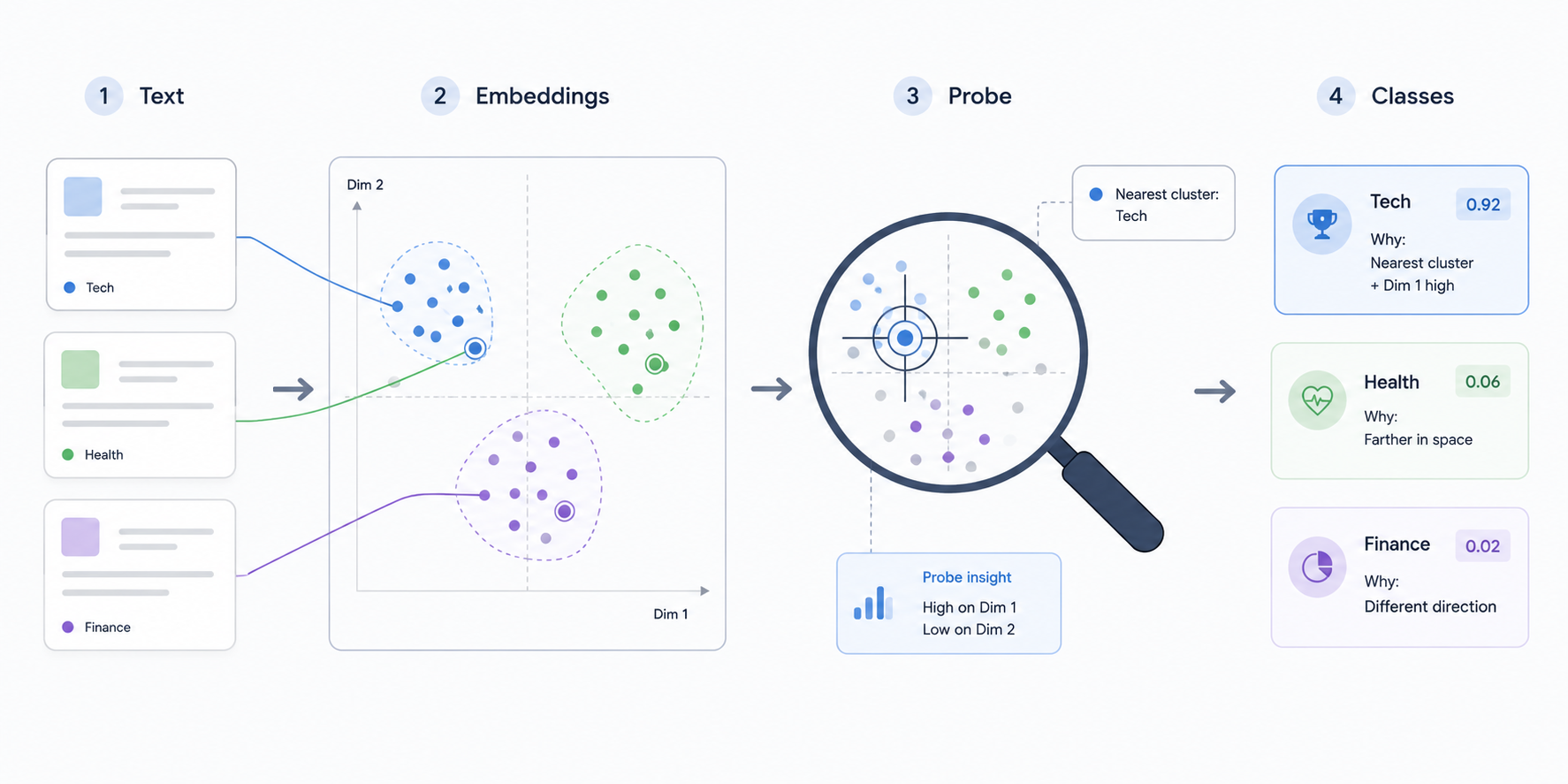 Interpretable Text Classification: Probing Scikit-LLM Embedding Spaces
Source: Machine Learning Mastery
Interpretable Text Classification: Probing Scikit-LLM Embedding Spaces
Source: Machine Learning Mastery
In this tutorial, we will explore the evolution of Mixture-of-Experts (MoE) models, dive deep into interpretable text classification using Scikit-LLM, and address a critical performance trap that many engineers fall into when scaling their AI-driven sites.
Learning Objectives
By the end of this guide, you will be able to:
- Understand the architectural shifts from early MoE models to the massive 900-expert layers of 2026.
- Implement interpretable text classification using Scikit-LLM and probing classifiers.
- Visualize high-dimensional embedding spaces using UMAP to identify data clusters.
- Apply SHAP values to explain model predictions to stakeholders.
- Calculate the mathematical viability of CDN caching to prevent performance degradation.
The Evolution of Sparse Intelligence: From Mixtral to Kimi K3
To understand where we are in 2026, we must look at how we process information. The dominance of Mixture-of-Experts (MoE) has redefined efficiency.
Mixture-of-Experts is a neural network architecture that uses a sparse gating mechanism to activate only a subset of the network's parameters (the 'experts') for any given input.
In the past, models like Mixtral 8x7B utilized a handful of experts. However, the 2026 standard, exemplified by models like Kimi K3, has evolved to utilize nearly 900 experts per layer. This massive expansion is not just about size; it's about specialization. Modern MoE models use advanced compression and stability mechanisms that keep these sparse designs trainable and efficient. For businesses, this means lower inference costs because you are only 'paying' for the compute power of the active experts, even if the total model size is in the trillions of parameters.
At Ailigent, we have found that leveraging these sparse architectures allows our clients to run highly specialized tasks—such as legal document analysis or medical coding—with the accuracy of a giant model but the speed of a much smaller one.
Tutorial: Interpretable Text Classification with Scikit-LLM
One of the biggest risks in 2026 is the "Black Box" problem. If your AI classifies a customer support ticket incorrectly, you need to know why. This is where Scikit-LLM and probing classifiers come in.
Step 1: Setting up the Probing Classifier
A probing classifier is a lightweight model trained on top of frozen embeddings to predict specific properties or labels.
from skllm.models.gpt.classification import GPTClassifier
from skllm.datasets import get_classification_dataset

# Initialize the classifier with a 2026-optimized model
clf = GPTClassifier(model="gpt-4o-2026-v2")

# Fit the model
clf.fit(X_train, y_train)
labels = clf.predict(X_test)
Step 2: Visualizing with UMAP
 From Mixtral to Kimi K3: How Mixture-of-Experts Models Evolved
Source: freeCodeCamp
From Mixtral to Kimi K3: How Mixture-of-Experts Models Evolved
Source: freeCodeCamp
To see if your embeddings are actually separating your data classes effectively, we use UMAP (Uniform Manifold Approximation and Projection). It reduces the high-dimensional space of LLM embeddings into a 2D or 3D map.
If you see a messy cloud of points where different categories overlap, your model will likely struggle with classification. Clear clusters indicate a high-quality embedding space.
Step 3: Interpreting with SHAP
SHAP (SHapley Additive exPlanations) is a game-theoretic approach to explain the output of any machine learning model.
By applying SHAP to our Scikit-LLM pipeline, we can see exactly which words or phrases influenced the classification. For example, if a text is classified as "High Priority," SHAP might highlight words like "urgent," "leak," or "failed." This level of transparency is vital for regulatory compliance in 2026.
| Feature | Traditional LLM | Interpretable Scikit-LLM (2026) |
|---|---|---|
| Transparency | Low (Black Box) | High (SHAP/UMAP) |
| Auditability | Difficult | Easy with Probing Classifiers |
| Compute Cost | High (Full Fine-tuning) | Low (Probing on Embeddings) |
| Deployment Speed | Slow | Rapid |
The Infrastructure Trap: When Your CDN Makes AI Slower
As we deploy these advanced models, we often wrap them in static or dynamic websites. A common mistake in 2026 is the blind application of CDN (Content Delivery Network) caching.
You might assume that adding a CDN always makes a site faster. However, if your cache hit rate is low, you are actually adding an extra "hop" to every request. This increases the Time to First Byte (TTFB).
The Math of Latency
Consider this scenario:
- Direct Request: 50ms
- CDN Overhead (Cache Miss): 30ms additional delay
- Cache Hit Rate: 10%
If 90% of your users are experiencing a cache miss, your average latency becomes:
(0.10 * 50ms) + (0.90 * (50ms + 30ms)) = 5ms + 72ms = 77ms.
In this case, your "optimization" made the site 54% slower. For AI applications where inference time is already a factor, this extra latency can kill the user experience. Always calculate your expected hit rate before implementing global caching strategies.
Try It Yourself: Interpretability Exercise
- Data Prep: Take a small dataset of 100 product reviews.
- Embed: Use Scikit-LLM to generate embeddings.
- Probe: Train a simple Logistic Regression on those embeddings.
- Visualize: Use UMAP to plot the results. Do the 'Positive' and 'Negative' reviews cluster separately?
- Explain: Run a SHAP explainer on one 'Negative' review. Which word was the strongest predictor of the negative sentiment?
Next Steps for Further Learning
To continue your journey in 2026's AI landscape, I recommend exploring the following:
- Sparse Autoencoders: The next frontier in understanding internal MoE activations.
- Agentic Workflows: Moving from single prompts to multi-step reasoning chains.
- Edge AI Deployment: How to run 900-expert MoE models on local hardware using advanced quantization.
At Ailigent, we believe that the future belongs to those who can not only build AI but also explain and optimize it. If you are looking to integrate these technologies into your business, reach out to Abo-Elmakarem Shohoud for a strategic consultation.
Key Takeaways
- Interpretability is non-negotiable: Use probing classifiers and SHAP values to move beyond black-box AI and ensure business accountability.
- MoE is the efficiency king: Leverage Mixture-of-Experts models like Kimi K3 to achieve high performance with lower compute costs through sparse activation.
- Infrastructure math matters: Don't assume a CDN or a cache will automatically improve performance; measure your cache hit rate and TTFB to avoid slowing down your AI applications.