The 2026 AI Turning Point: From Profit Milestones to Agentic Governance

The 2026 AI Turning Point: From Profit Milestones to Agentic Governance
As of February 5, 2026, we are no longer talking about the "potential" of Artificial Intelligence. We are living in its era of maturation. The early experiments of the mid-2020s have crystallized into massive revenue streams and critical infrastructure that powers everything from global cloud computing to the front lines of patient care.
 Illustration
Source: Dev.to AI
Illustration
Source: Dev.to AI
In this post, we’ll break down three pivotal developments that define the current state of automation and AI, and what they mean for your business strategy this year.
1. The $400 Billion Benchmark: AI is the Growth Engine
Alphabet’s recent Q4 2025 earnings report, released just this week, serves as a financial manifesto for the AI age. For the first time, Google’s parent company topped $400 billion in annual revenue. This 15% year-over-year growth isn't just about search ads; it is a direct result of the massive expansion in AI-driven cloud services and YouTube’s algorithm refinements.
The Insight for Business Owners: If the giants of the industry are seeing double-digit growth by integrating AI into their core infrastructure, the "wait and see" approach is officially obsolete. In 2026, the cloud is no longer just a storage space—it’s a processing hub where AI agents live. Businesses that aren't leveraging AI-native cloud solutions are essentially operating with a hand tied behind their backs.
2. Voice AI in Healthcare: Solving the 'Clerical Tax'
One of the most inspiring applications we are seeing in early 2026 is the revolution in healthcare. For years, clinician burnout was treated as an emotional or physical problem. Today, we recognize it as an administrative one. Clinicians have long been burdened by a "clerical tax"—spending more time documenting patient interactions than actually healing people.
 Illustration
Source: The Verge AI
Illustration
Source: The Verge AI
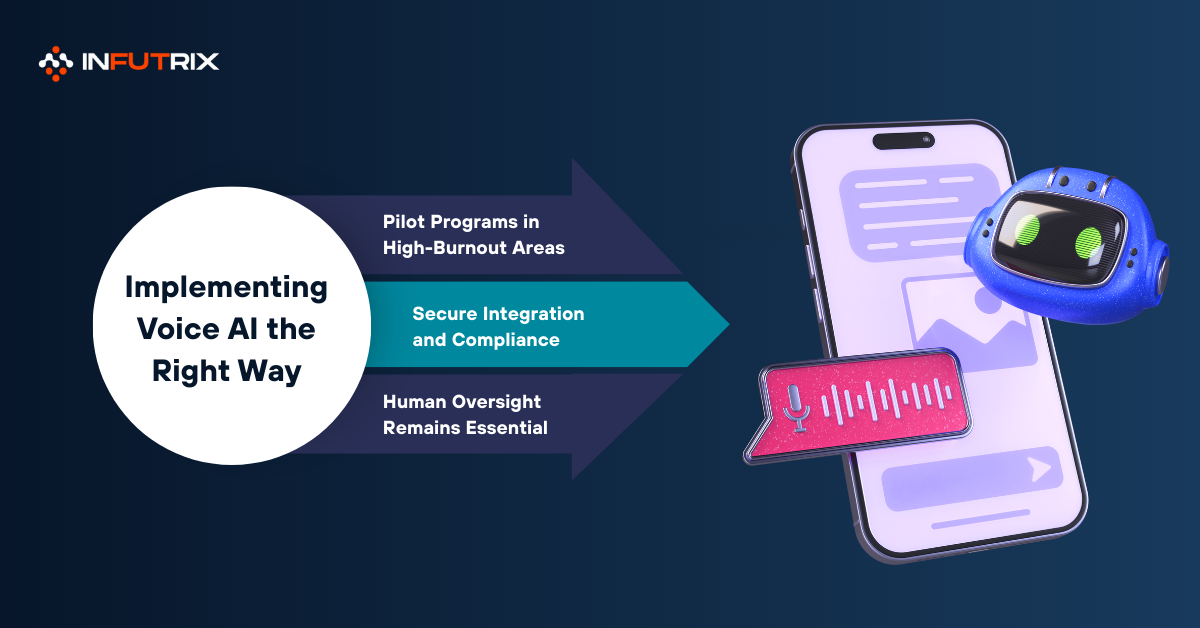
Voice AI is finally dismantling this burden. Modern Voice AI development services have moved beyond simple transcription. These systems now utilize ambient listening to understand context, extract clinical data, and automatically update Electronic Health Records (EHR) in real-time.
Why This Matters Beyond Healthcare: This use case is a blueprint for any industry suffering from documentation fatigue. Whether it’s legal services, field engineering, or corporate sales, the transition from manual data entry to intelligent observation is where the biggest productivity gains lie in 2026.
3. The Shift to Agentic Governance
As we deploy more "Agentic Systems"—AI that doesn't just answer questions but takes actions, makes purchases, and manages workflows—the risks have evolved. We are moving past simple "guardrails" and "prompts."
As highlighted by recent insights from MIT Technology Review, rules often fail at the prompt level. In 2026, a CEO’s primary responsibility regarding AI isn't just adoption; it’s governance. Agentic AI requires boundaries at the system level, not just the user interface. If an AI agent has the authority to negotiate a contract or manage a supply chain, who is responsible when the system finds a logic loophole?
Actionable Strategies for 2026:
- Define System Boundaries: Move away from trying to control what a user types (prompts) and focus on what the AI system is technically allowed to do (API permissions and data access).
- Audit for Autonomy: Regularly review the "degree of agency" your AI tools have. Ensure there is always a "Human-in-the-Loop" for high-stakes financial or legal decisions.
Business Takeaways for the Remainder of 2026
- Prioritize Vertical AI: Don't just use general AI tools. Look for specialized solutions—like the Voice AI tools used in healthcare—that solve specific industry bottlenecks.
- Modernize Your Cloud Stack: Ensure your digital infrastructure can handle the demands of agentic workflows. If you aren't on an AI-optimized cloud platform by now, 2026 is the year to migrate.
- Implement an AI Governance Framework: Stop treating AI security as an IT problem. It is a board-level risk management issue. Establish clear governance protocols for autonomous agents before they are fully integrated into your operations.
Conclusion
2026 is proving to be the year where AI delivers on its promise of efficiency, provided it is implemented with a clear focus on governance and specialized utility. The milestone $400 billion revenue figures we see today are just the beginning of a total economic restructuring.
Is your business ready to lead, or are you still documenting your processes manually?
Interested in automating your business workflows for 2026? Let's connect and build the future together.
Related Videos
Bloomberg Surveillance 2/2/2026
Channel: Bloomberg Television
He Built A Fence Just To Punish Neighbors 😵
Channel: Zack D. Films