The AI Financial Frontier: Decoding Google’s Expansion and the Future of Intelligent Capital in 2026

By Abo-Elmakarem Shohoud | Ailigent
The Great Convergence: Finance Meets Agentic Intelligence
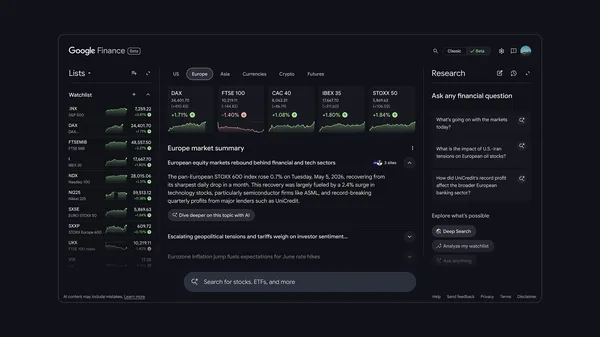 The new AI-powered Google Finance is expanding to Europe.
Source: Google AI Blog
The new AI-powered Google Finance is expanding to Europe.
Source: Google AI Blog
In May 2026, the global financial landscape is no longer defined by who has access to data, but by who can synthesize it the fastest. Google’s recent announcement regarding the expansion of its AI-powered Finance experience into the European market marks a pivotal moment in this evolution. This is not merely a localized product update; it represents the democratization of institutional-grade financial intelligence for the common entrepreneur and the mid-sized business owner.
Agentic AI is a paradigm where AI systems do not just process information but actively pursue goals and execute tasks autonomously within defined parameters. In the context of Google Finance’s expansion, we are seeing the first widespread implementation of consumer-facing agentic layers in wealth management. For business leaders, this shift necessitates a fundamental rethink of how capital allocation and risk management are handled in a hyper-automated world.
Why the European Expansion Matters in 2026
Europe has long been a complex battleground for big tech, defined by stringent regulatory frameworks like the AI Act and GDPR. Google’s successful rollout of its AI Finance suite across the EU suggests that the technology has reached a level of maturity where it can balance predictive power with the transparency required by European law.
For businesses operating in 2026, the integration of these tools means that real-time currency fluctuations, pan-European market sentiment, and cross-border regulatory shifts are now summarized in a unified, semantic interface. We are moving away from static charts and toward "conversational capital." Business owners can now ask their financial interfaces, "How will the projected inflation in the Eurozone affect my supply chain costs in North Africa over the next quarter?" and receive a multi-variate analysis based on live data.
The Shift from Data Access to Insight Synthesis
Historically, financial platforms were repositories of raw data. In 2026, the value proposition has shifted to synthesis. Google Finance’s AI doesn't just show you that a stock is down; it connects the dots between a geopolitical event in the Middle East, a manufacturing delay in Southeast Asia, and the subsequent impact on a specific portfolio in Berlin.
At Ailigent, we have observed that companies leveraging these synthesized insights are reducing their decision-making cycles by up to 40%. Abo-Elmakarem Shohoud has consistently advocated for this transition: moving from reactive monitoring to proactive, automated strategy. When your financial tools can predict a liquidity crunch before it happens, your business gains a competitive moat that was previously reserved for high-frequency trading firms.
Comparing the Financial Intelligence Eras
To understand the magnitude of this shift, let us compare the traditional approach to the 2026 AI-driven model:
| Feature | Traditional Finance (Pre-2024) | AI-Powered Finance (2026) |
|---|---|---|
| Data Processing | Manual analysis of spreadsheets and news | Real-time semantic synthesis of global events |
| Market Sentiment | Lagging indicators and expert opinions | Instant NLP analysis of millions of data points |
| Risk Assessment | Static models updated quarterly | Dynamic, agentic simulations updated hourly |
| Accessibility | Restricted to high-net-worth/institutional | Democratized for SMBs and retail investors |
| Interface | Complex dashboards and tickers | Natural language queries and AI assistants |
Predictive Modeling and the SMB Advantage
One of the most profound implications of Google's expansion is the empowerment of Small and Medium Businesses (SMBs). In the past, sophisticated predictive modeling was the domain of those who could afford expensive Bloomberg terminals or proprietary quant teams. In 2026, a boutique agency in Cairo or a tech startup in Warsaw can access the same predictive depth through integrated AI platforms.
Predictive Modeling is a mathematical process that uses data mining and probability to forecast outcomes. By embedding this directly into a search-adjacent product like Google Finance, Google is making 'future-proofing' a standard feature of business management. Business owners are no longer looking at what happened yesterday; they are navigating based on what is likely to happen tomorrow.
The Role of Ailigent in the New Economy
As these tools become ubiquitous, the challenge for business leaders shifts from finding the tools to integrating them into a cohesive automation strategy. This is where the expertise of Abo-Elmakarem Shohoud and the Ailigent team becomes critical. While Google provides the data and the AI interface, Ailigent provides the strategic architecture to turn those insights into automated workflows.
For instance, an AI-powered financial signal from Google Finance can now trigger an automated hedging strategy within a company’s ERP system, managed by Ailigent’s custom automation layers. This level of synchronization is what separates the leaders of 2026 from those still stuck in the manual processes of the past.
Non-Obvious Perspectives: The Risk of Algorithmic Homogeneity
A contrarian view to consider is the risk of "algorithmic homogeneity." If every business owner in Europe and beyond is using the same Google AI to make financial decisions, we might see a reduction in market diversity. When everyone’s AI assistant suggests the same "optimal" investment or risk mitigation strategy, it could lead to flash-volatility or crowded trades.
Strategic leaders should use these AI tools as a baseline, not a ceiling. The real alpha in 2026 comes from combining AI-driven insights with unique, human-centric business intuition. Use the AI to handle the 90% of data crunching, but reserve the final 10% for creative, non-linear strategic moves that the algorithms cannot yet replicate.
Strategic Advice for Business Leaders in 2026
- Audit Your Data Literacy: Ensure your finance team understands how to prompt and interpret AI-generated financial models. The skill of the future is "Financial Prompt Engineering."
- Integrate, Don’t Just Observe: Don't let Google Finance be a tab you just check. Use APIs to pull these AI insights into your internal decision-making software.
- Prioritize Ethical AI: Especially in the European market, ensure your use of financial AI complies with the latest transparency standards to avoid regulatory friction.
- Invest in Custom Automation: While public tools like Google Finance are powerful, custom solutions developed by firms like Ailigent provide the specific edge needed for your unique industry niche.
Bottom Line: The Key Takeaways
- Democratized Intelligence: Google’s expansion into Europe brings institutional-grade AI financial analysis to businesses of all sizes, leveling the playing field in 2026.
- Real-Time Synthesis: The shift from raw data to semantic insights allows for faster, more accurate decision-making and risk assessment.
- Agentic Future: We are entering an era where financial tools don't just inform us; they act as agents that help navigate complex global markets.
- Strategic Differentiation: To win in 2026, leaders must use AI as a foundation while maintaining a unique strategic vision that transcends algorithmic suggestions.
Related Videos
Earn a Premium Salary as a Business Analyst in Fintech!
Channel: Business Analytics by SkillArbitrage
[Deloitte] scrum master interview question I scrum master interview questions and answers
Channel: CareersTalk